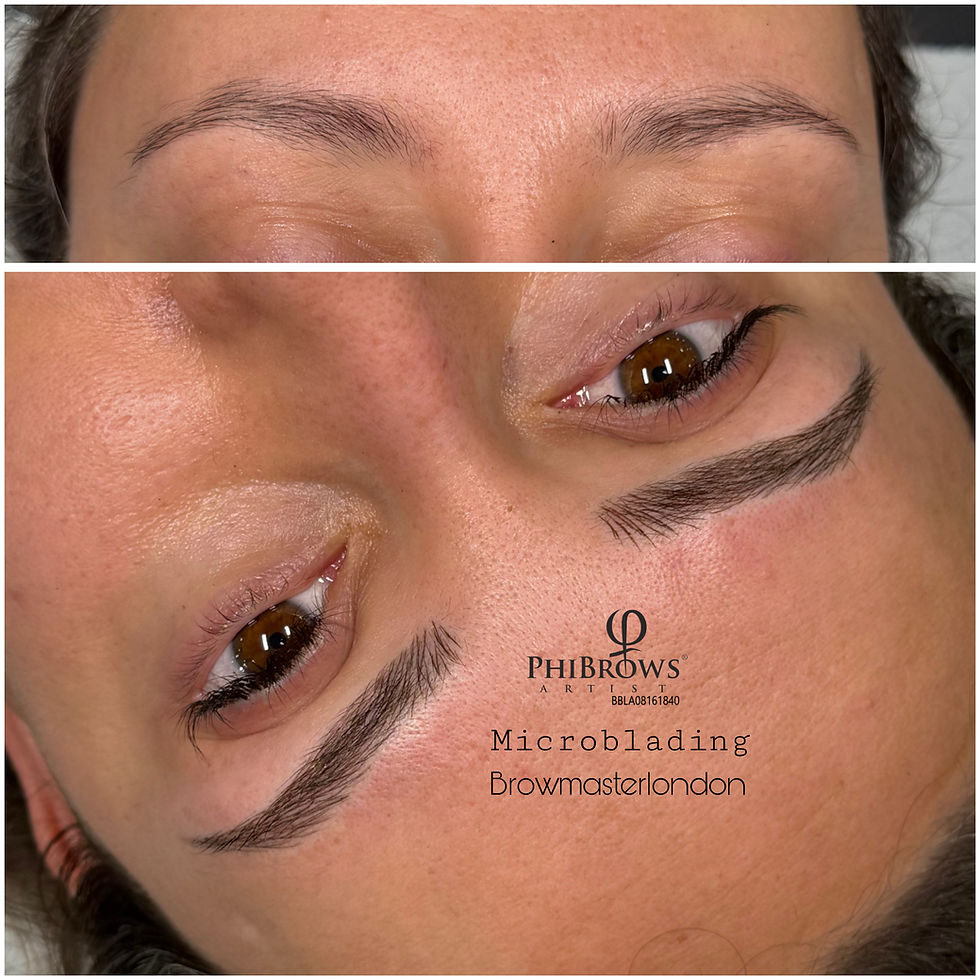
How Long Does Microblading Last? (And What Affects It)
- Anna Nguyen

- Jun 14
- 5 min read

One of the most common questions we get before booking is: how long does microblading actually last?
The honest answer is: it varies. The range you'll see quoted most often is 12–24 months, and that's accurate — but it's a wide range, and where you land within it depends on several factors that are worth understanding before you commit.
This guide covers everything that affects microblading longevity, how nano hairstrokes compare, and what you can do to make your results last as long as possible.
The Short Answer
For most clients, microblading lasts 12–18 months before a colour boost is needed. Clients with drier skin and a careful aftercare routine can sometimes push to 24 months. Clients with oily skin or active lifestyles may find their results fading closer to the 12-month mark.
Nano hairstrokes (nano blading) generally last longer — typically 18 months to 3 years — because the machine method deposits pigment more precisely and at a more consistent depth.
What Affects How Long Microblading Lasts?
1. Skin Type — The Biggest Factor
Skin type has more impact on longevity than almost anything else.
Dry to normal skin holds microblading pigment best. The strokes stay crisp, and the colour fades gradually and evenly over 18–24 months.
Oily skin is the most challenging for microblading. Excess sebum breaks down pigment faster, causing strokes to blur and fade more quickly — sometimes within 12 months or less. If you have oily skin, nano hairstrokes are often a better long-term investment.
Combination skin falls in the middle. Results can be good, but oilier zones (typically the centre of the brow) may fade faster than the tails.
Mature or thinning skin can sometimes retain pigment for longer, though healing can be slower and results less predictable. A thorough consultation is especially important for mature skin.
2. Sun Exposure
UV light is one of the fastest ways to fade microblading pigment. The sun breaks down the pigment particles in the skin over time, causing the colour to lighten and the strokes to lose definition.
If you spend a lot of time outdoors, on holiday, or in sunny climates, expect to need a colour boost sooner. Applying SPF to your brows daily once fully healed significantly extends longevity.
3. Skincare Routine
Certain skincare ingredients accelerate pigment fading and should be avoided in the brow area long-term:
Retinol and retinoids — speed up cell turnover, which pushes pigment out faster
AHAs and BHAs (glycolic acid, salicylic acid) — exfoliate the upper layers of skin where microblading pigment sits
Vitamin C serums — can lighten pigment over time
Exfoliating scrubs — mechanical exfoliation near the brows speeds fading
This doesn't mean you can't use these products on the rest of your face — just keep them away from the brow area.
4. Lifestyle
An active lifestyle can affect longevity in a few ways:
Heavy sweating — regular intense exercise, saunas, or steam rooms increase the rate at which pigment fades. The salt in sweat gradually breaks down the pigment over time.
Swimming — chlorinated and saltwater both accelerate fading, particularly with frequent exposure.
Skincare habits — clients who cleanse and moisturise the brow area heavily (rather than gently) tend to see faster fading.
None of these are reasons not to get microblading — just factors to be aware of when setting expectations.
5. The Initial Healing Process
The way your brows heal after the first session sets the foundation for longevity. Picking at flaking skin, getting the brows wet too soon, or skipping the perfecting touch-up all reduce how well the pigment settles.
The perfecting touch-up at 6–8 weeks is essential — this is where any gaps or uneven fading from the initial healing are corrected, and where the result is properly refined. Skipping this appointment often means shorter-lasting results.
6. Pigment Quality and Artist Technique
The depth at which pigment is deposited matters enormously. Too shallow and it fades quickly; too deep and it can blur or change colour over time. An experienced artist deposits pigment at the correct depth consistently — which is one of the main reasons results vary so much between studios.
At Brow Master London, we use high-quality pigments from trusted brands and apply them at the correct depth for each individual skin type. This directly affects how long your results last and how cleanly they fade when a colour boost is eventually needed.
How to Make Your Microblading Last Longer
Follow aftercare instructions precisely for the first 14 days
Keep the brow area dry for the first 10 days
Don't pick or rub flaking skin
Attend your perfecting touch-up appointment
Apply SPF to your brows daily once fully healed
Avoid retinol, AHAs and exfoliating skincare near the brows
Limit time in saunas, steam rooms and chlorinated pools
Book a colour boost before the pigment fades completely — refreshing well-faded brows is simpler and less expensive than correcting fully faded, uneven ones
When Should You Book a Colour Boost?
The right time to book a colour boost is when you notice the colour starting to fade or the strokes losing definition — typically around the 12–18 month mark for microblading. You don't need to wait until the brows have completely faded.
Refreshing at the right time means:
The top-up is simpler and quicker
Results look more consistent
Less pigment is needed to restore the original result
Leaving it too long means more work to restore the original result and, in some cases, the pigment may fade to a tone that needs correcting before refreshing.
Microblading vs Nano Hairstrokes: Which Lasts Longer?
Microblading | Nano Hairstrokes | |
Typical longevity | 12–18 months | 18 months–3 years |
Best skin type for longevity | Normal to dry | Most skin types |
Colour boost frequency | Every 12–18 months | Every 18–36 months |
If longevity is your priority — particularly if you have oily, combination or mature skin — nano hairstrokes are worth considering. The machine method deposits pigment more precisely, which translates to longer-lasting, more stable results for a wider range of skin types.
You can read more in our full guide: Microblading vs Nano Hairstrokes: Which Is Right for You?
Frequently Asked Questions
Does microblading fade completely? Yes — microblading is semi-permanent, meaning it does fade over time as the body gradually breaks down the pigment. Most clients see a complete or near-complete fade within 2–3 years without any colour boost appointments.
Can microblading last 3 years? For most clients, 3 years is on the longer end for microblading without any top-ups. Nano hairstrokes are more likely to maintain definition at the 3-year mark. Individual results vary based on skin type and lifestyle.
Does microblading look bad as it fades? When done correctly with good-quality pigments, microblading fades gradually to a lighter version of the original colour rather than changing to an unwanted tone. Poor-quality pigments or incorrect technique can cause fading to blue, grey or red — another reason artist experience and pigment quality matter.
Is a colour boost the same as a full treatment? No — a colour boost is a shorter, simpler appointment that refreshes faded pigment. It's less involved than the original treatment and typically costs less. We'll advise on timing and what's needed at your touch-up appointment.
Ready to Book?
Brow Master London is a boutique, one-to-one studio in Notting Hill, led by Anna — a multi-award-winning PhiBrows artist and 2025 UK WULOP Champion, with over 10 years' experience and 5,000+ clients.
Whether you're ready to book or still weighing up your options, we're happy to answer questions before you commit.